

A Physician’s Field Guide
You Reached Your Goal Weight — So Why Does Your Face Look Older?
What “Ozempic face” really is, why semaglutide and tirzepatide cause it, where newer drugs like retatrutide fit in — and how it’s treated without surgery.

Board-Certified in Internal Medicine & Obesity Medicine · Medical Director, Sanjiva Medical Spa · Updated June 2026
If you’ve lost a significant amount of weight on a GLP-1 medication and now feel your face looks hollow, gaunt, or older than before, you are not imagining it — and you are far from alone. It has a nickname: “Ozempic face.”
I sit at an unusual intersection. As a physician board-certified in both Internal Medicine and Obesity Medicine, I understand the metabolic side of these medications and the aesthetic side of what rapid weight loss does to the face. Many of the patients I now see for this concern had never had Botox, filler, or any aesthetic treatment before — the weight loss itself is what brought them in. So let’s talk about what’s actually happening, why it happens, which medications are involved, and the realistic, non-surgical options that restore it.
The reframe: it’s not one problem, it’s three
First, a clarification that matters: the medication is not damaging your face. “Ozempic face” is a colloquial term, and the effect isn’t unique to Ozempic — it follows any rapid, substantial weight loss, whether from semaglutide, tirzepatide, bariatric surgery, or aggressive dieting. These medications simply made this degree of weight loss accessible to millions of people who would never have had surgery.
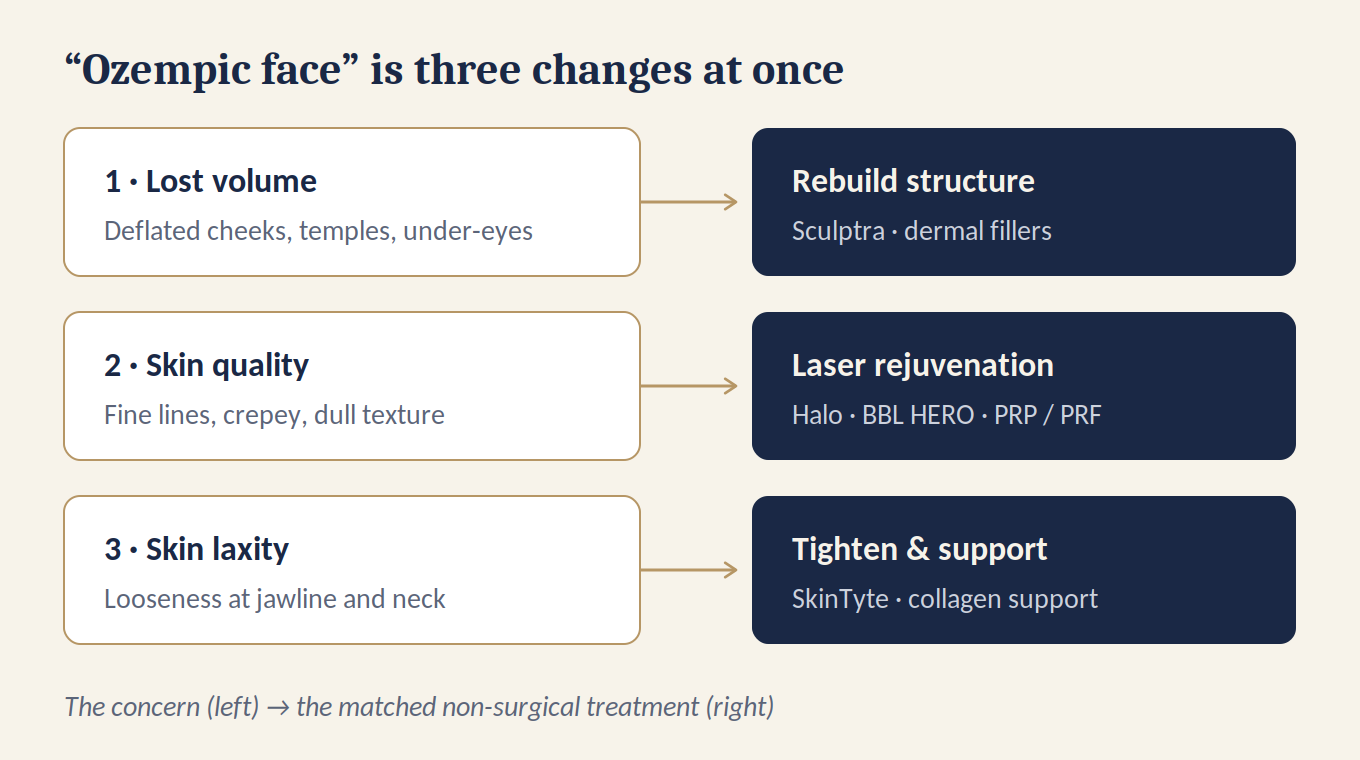
What you’re seeing is really three separate changes happening at once — which is exactly why a single treatment rarely fixes it:
1. Lost volume
The face holds discrete fat pads that give it youthful fullness. Rapid fat loss deflates them, producing hollow temples, flattened cheeks, and under-eye hollowing. This is the single biggest driver of the “aged” look.
2. Declining skin quality
Volume loss often coincides with reduced support for collagen and elastin, which accentuates fine lines and folds and leaves the surface looking more crepey and less luminous than before.
3. Skin laxity
When weight comes off faster than the skin can remodel, the skin can’t retract to the new, smaller contour — so it reads as looseness along the jawline and neck.
Think of it like letting the air out of a cushion: the cover that fit perfectly now has nothing underneath to fill it. Restoring the face means addressing all three layers, not just one — which is why honest practitioners talk about a plan rather than a single injection.
The medications behind it — and their real names
One source of confusion I hear constantly is the names. The same molecule is sold under different brand names depending on whether it’s approved for diabetes or for weight loss. Here’s the plain-English map, current as of 2026:
Semaglutide
A GLP-1 receptor agonist. It’s FDA-approved as Wegovy (weight loss), Ozempic (type 2 diabetes and cardiovascular risk reduction), and Rybelsus (an oral tablet for type 2 diabetes).1 An oral form of Wegovy for weight loss was also approved in late 2025, making it the first GLP-1 pill for obesity.2 In trials, semaglutide produces roughly 15% average body-weight loss.
Tirzepatide
A dual GIP/GLP-1 receptor agonist — it works on two hunger-regulating pathways instead of one. It’s FDA-approved as Zepbound (weight loss, and moderate-to-severe obstructive sleep apnea) and Mounjaro (type 2 diabetes).1 Tirzepatide tends to produce greater weight loss than semaglutide — on the order of 20–22% in trials — which also means the facial changes can be more pronounced.
Retatrutide (still investigational as of June 2, 2026)
This is the one generating the most buzz, and the one I field the most questions about. Retatrutide is a triple hormone receptor agonist — it targets GIP, GLP-1, and glucagon, earning it the nickname “triple-G.” In Eli Lilly’s Phase 3 TRIUMPH program reported through 2026, higher doses produced average weight loss of roughly 28% over 80 weeks — approaching results historically associated with bariatric surgery.3 The crucial caveat: retatrutide is not FDA-approved. It is investigational and, at the time of writing, legally available only to participants in clinical trials, with a possible approval window in 2027–2028.3
The reason I walk patients through all of this is that the more effective the medication, the faster and larger the weight loss — and the more likely the face is to need support along the way. That’s a planning conversation, not an afterthought.
Why it happens — and who it hits hardest
All of these drugs drive weight loss by reducing appetite and slowing how quickly the stomach empties, so you eat less and lose fat throughout the body — including the face. The degree of facial change varies. Patients over 40 tend to see more dramatic effects, because skin elasticity and baseline collagen are already lower. The total amount and the speed of weight loss matter too. And there’s one factor that’s partly in your control: patients who lose weight rapidly without preserving muscle — through adequate protein and resistance training — tend to experience more pronounced facial changes. That’s a conversation I have at the start of every weight-loss plan, because some prevention is possible while the weight is still coming off.
How common is this, really?
Common enough that it’s now studied formally. Published 2026 data on patients using GLP-1 medications reported that a majority experienced midface volume loss, about half experienced some skin laxity, and roughly a third noted increased facial wrinkles.5 In other words, if you’re noticing it, you’re in the majority — not the exception.
The non-surgical treatments that actually restore it
Because the problem has three parts, the solution is usually a combination, staged across visits rather than done all at once. Here’s how we think about each layer.
Rebuilding volume: biostimulator injectables
For the deflation at the heart of Ozempic face, the goal isn’t simply to “fill” — it’s to rebuild the underlying structure. Biostimulators like Sculptra prompt your own collagen to regenerate gradually, which tends to look more natural than placing large volumes of traditional filler into a face that has lost its own support. Targeted dermal fillers can refine specific areas like temples or under-eye hollows.
Improving skin quality: laser skin rejuvenation
For texture, fine lines, and tone, our Sciton platform does the work. Halo and BBL HERO address surface quality and sun damage, while SkinTyte targets early laxity. Which one fits depends on your skin — that’s a consultation conversation, not a one-size answer.
Supporting regeneration: PRP & PRF
For overall skin quality — and the delicate under-eye area specifically — regenerative treatments using your own platelet-rich plasma or fibrin can amplify the skin’s repair signaling. Our PRP facials and EZGel PRF under-eye treatment use your body’s own growth factors, which appeals to patients who want the most natural pathway available.
“The patients I see for GLP-1 facial changes don’t want to look like someone else. They want to look like themselves — the version they remember before the weight loss aged their face. That’s a very achievable goal, and it rarely requires surgery.”
The part most clinics won’t tell you: sometimes you should wait
If you’re still actively losing weight, your face is still changing — and restoring volume to a moving target can mean redoing work later. In those cases I’ll often recommend reassessing in a few months so we restore volume to a stable baseline, rather than treating today. That’s not a sales decision; it’s the medically sound one. Knowing when to treat is as important as knowing how — and it’s exactly the kind of judgment that benefits from a physician who understands both sides of your weight-loss journey.
Where Sanjiva fits in
GLP-1 facial change is one of the few aesthetic concerns where the medical and cosmetic pictures are genuinely intertwined — where you are in your weight-loss journey, which medication you’re on, whether you’re preserving muscle, and what’s realistic to correct now versus later are all clinical judgments. At Sanjiva Medical Spa in Dallas, we work with patients across Highland Park, University Park, and Preston Hollow, and we approach this the way we approach everything: physician-led evaluation, evidence-based, and built around restoring your face — not chasing a trend. If you’re also exploring weight loss itself, our medically supervised weight-loss program is directed by a board-certified Obesity Medicine physician, so the metabolic and aesthetic sides stay coordinated under one roof.
Let your face catch up to your progress.
Book a consultation with our Expert Nurse Injectors to understand what’s happening and build a safe, realistic plan to restore it.
Book Your Complimentary Consultation
Sanjiva Medical Spa · 5633 W Lovers Lane, Dallas, TX 75209 · (214) 245-9999
Frequently asked questions
What is Ozempic face?
It’s a non-medical term for the facial changes that can follow rapid weight loss on GLP-1 medications such as semaglutide (Ozempic, Wegovy) or tirzepatide (Mounjaro, Zepbound) — typically a combination of lost facial volume, reduced skin quality, and skin laxity. It’s driven by the speed and amount of fat loss, not by the drug damaging the skin directly.
Is Ozempic face caused only by Ozempic?
No. Despite the nickname, it can follow any GLP-1 medication — semaglutide (Ozempic, Wegovy, Rybelsus) or tirzepatide (Mounjaro, Zepbound) — and indeed any rapid, substantial weight loss, including from dieting or bariatric surgery. More effective medications tend to produce faster loss and therefore more noticeable facial change.
What about retatrutide — is it available?
Not yet as of June 2, 2026. Retatrutide is an investigational triple-agonist drug that has shown very high weight loss in Phase 3 trials, but it is not FDA-approved and is legally available only through clinical trials, with potential approval estimated for 2027–2028. Anyone selling “retatrutide” outside a trial is operating outside legal and safety bounds.
Can Ozempic face be treated without surgery?
In most cases, yes. Non-surgical options include biostimulator injectables like Sculptra to rebuild volume, laser skin rejuvenation to improve skin quality and tightness, and regenerative treatments such as PRP and PRF. The plan usually combines several approaches staged across visits. Surgery is reserved for severe laxity.
Can you prevent Ozempic face?
You can reduce it. Losing weight at a gradual pace, staying well-hydrated, and preserving muscle with adequate protein and resistance training all help the skin and face adapt. Starting collagen-supportive treatments early can also help. It can’t always be fully prevented, but proactive planning makes a real difference.
Where can I get Ozempic face treatment in Dallas?
Sanjiva Medical Spa on W Lovers Lane offers physician-led evaluation and non-surgical treatment for GLP-1 related facial changes, serving patients from Highland Park, University Park, Preston Hollow, and across Dallas. You can book a complimentary consultation online or by calling (214) 245-9999.
References
- U.S. Food & Drug Administration approval records and prescribing information for semaglutide (Wegovy, Ozempic, Rybelsus) and tirzepatide (Mounjaro, Zepbound). Brand names and indications summarized as of 2026.
- Novo Nordisk / FDA (December 2025). FDA approval of oral semaglutide (Wegovy tablet) for chronic weight management — first oral GLP-1 for obesity.
- Eli Lilly and Company (2026). TRIUMPH Phase 3 program topline results for retatrutide (LY3437943), a GIP/GLP-1/glucagon triple receptor agonist; Drugs.com retatrutide status summary (investigational; not FDA-approved). drugs.com
- U.S. Food & Drug Administration (April 30, 2026). Proposal to exclude semaglutide, tirzepatide, and liraglutide from the 503B Bulk Drug Substances List absent a drug shortage.
- Plastic Surgery Practice / The Aesthetic Society (2026), reporting on the prevalence of facial volume loss, skin laxity, and wrinkles among patients using GLP-1 receptor agonists for weight loss. Figures illustrate observed patterns; individual experience varies with age, genetics, and rate of weight loss.
This article is for general educational purposes and is not a substitute for individualized medical advice; it does not establish a physician–patient relationship. Medication names and approval statuses are summarized as of June 2026 and may change. GLP-1 medications and aesthetic treatments carry individual risks and benefits, and results vary. Decisions about prescription weight-loss medication should be made with the clinician managing your care. Reviewed and authored by Dr. Praveen Guntipalli, MD, FACP — board-certified in Internal Medicine and Obesity Medicine, Medical Director of Sanjiva Medical Spa, Dallas, TX.