
A Physician’s Field Guide
You Already Have Abs. Here’s the One Number That Decides Whether You See Them.
Why visible abs have almost nothing to do with crunches — and everything to do with your body fat percentage.
If you’ve ever done hundreds of crunches and wondered why your abs still aren’t showing, here’s the part most fitness content skips: the muscle is already there. The rectus abdominis — the “six-pack” muscle — exists in every healthy adult. Whether it’s visible comes down to a single variable: how much body fat sits on top of it.
As a board-certified Obesity Medicine physician practicing here in Dallas, I spend a lot of time helping patients separate what actually moves the needle from what just feels productive. So let’s talk about the real metric, the healthy ranges for men and women, how to actually measure it, and — just as important — where chasing a lower number stops being healthy.
The reframe: abs are uncovered, not built
Think of your abdominal muscles like furniture under a blanket. No matter how much you reshape the furniture, you won’t see its outline clearly until the blanket gets thin enough. That “blanket” is subcutaneous fat. This is why two people can do the exact same core workout and only one shows definition — the difference is the fat layer, not the effort.
So the real question was never how do I get abs. It’s how do I reveal the ones I already have — safely, and at a level that’s sustainable for my body.
The metric that matters: body fat percentage
Weight on the scale and BMI both fall short here, because neither tells you the ratio of fat to lean mass. Two people at the same weight can look completely different depending on body composition. The number that actually predicts ab visibility is your body fat percentage — and the threshold where definition appears is different for men and women. That difference is biology, not a difference in discipline.
For men
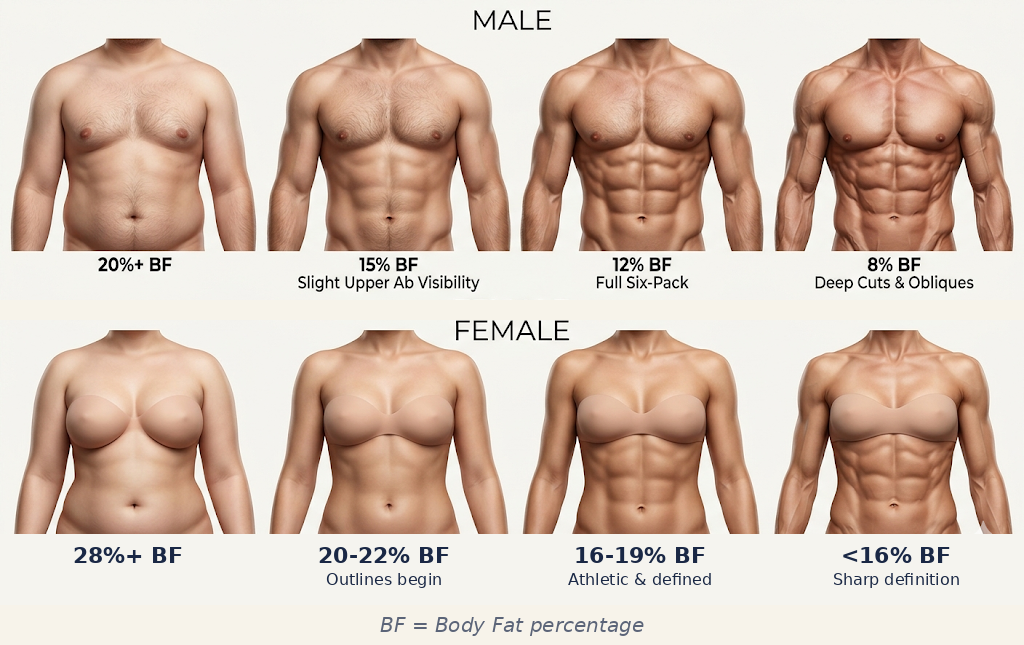
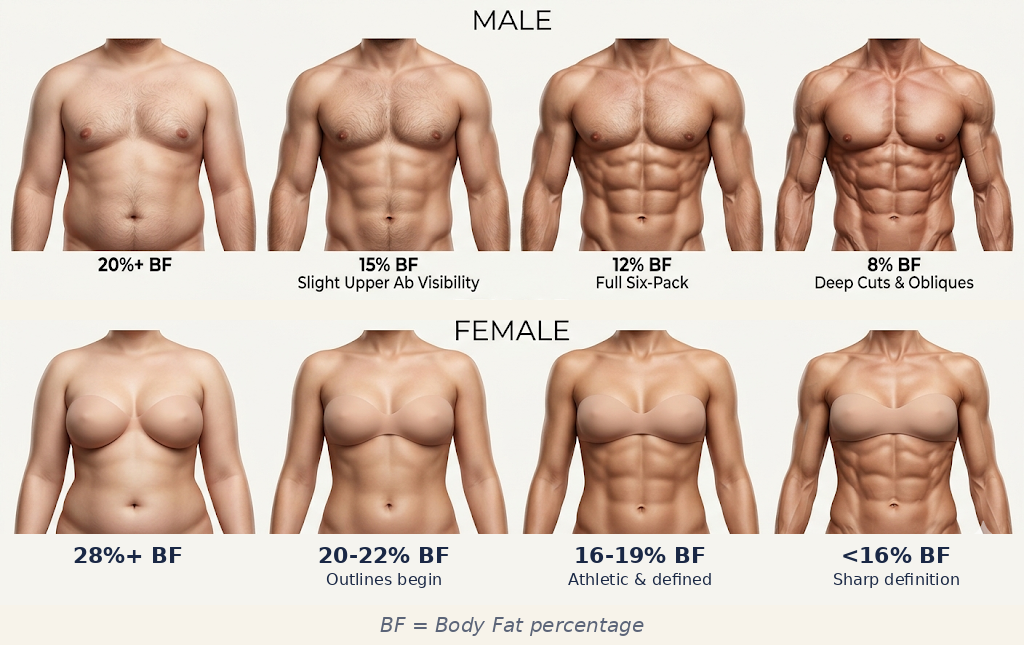
- Around 15% body fat — the upper abs start to show in good lighting.
- Around 12% — a full, visible six-pack.
- Around 8–10% — deep definition and visible obliques.
Most men first see their abs somewhere in the 10–15% range.
For women
- Around 20–22% body fat — outlines begin to appear.
- Around 16–19% — an athletic, defined midsection.
- Below 16% — sharp definition.
Women’s ranges sit roughly eight points higher than men’s, and that’s by design. According to the American Council on Exercise, women carry more essential fat — about 10–13% versus 2–5% in men — the baseline fat required for hormone production, reproductive health, and normal physiology.1 This isn’t a sign of being “less lean.” It’s how a healthy female body is supposed to work.
How to actually measure your body fat percentage
You can’t manage what you can’t measure — and not all methods are created equal. Here’s how the common options compare, from most convenient to most accurate:
- Visual estimate / progress photos. Free and surprisingly useful for tracking change over time, but not for a precise number. Use the chart above as a rough reference.
- Smart scales & handheld BIA devices. These send a small electrical current through the body (bioelectrical impedance). Convenient, but readings swing with hydration, food, and time of day — best used at the same time of day to track trends, not absolute numbers.
- Skinfold calipers. Inexpensive and reasonably reliable in trained hands, but results depend heavily on technique.
- DEXA scan. Widely regarded as the gold standard — it measures fat, lean mass, and bone density, and even shows visceral (around-the-organs) fat that a scale can’t.2
A practical rule: pick one method and stay consistent. The trend over weeks matters more than any single reading. If you want a clinically meaningful baseline, a body-composition assessment with a clinician removes the guesswork — which is part of how we approach medical weight management at Sanjiva.
The part most accounts won’t tell you: lower isn’t always better
This is where having a physician in the conversation matters. Essential fat — the minimum your body needs to function — is roughly 2–5% in men and 10–13% in women. The American Council on Exercise considers sustained levels below about 6% for men and 14% for women dangerously low.1 Pushing below healthy ranges carries real consequences:
- In women, dropping too low can disrupt the menstrual cycle, lower estrogen, and reduce bone density — a pattern clinicians historically called the Female Athlete Triad, and which the International Olympic Committee now describes more broadly as RED-S (Relative Energy Deficiency in Sport).3
- The same energy deficiency can weaken bones over time, raising the risk of stress fractures.3
- In both sexes, going too lean can impair hormone function and immune health.
So when someone asks me to help them “get to 12%,” my first job isn’t to hand them a plan — it’s to ask whether that target is even appropriate for their body, goals, and health history. Most content online gives you a number. A physician’s role is to tell you whether chasing it is safe for you.
“No two bodies respond the same way, so I don’t believe in one-size-fits-all targets. The real work is understanding the whole person — their hormones, their history, their goals — and then using the right combination of tools to get there safely. That’s what actually produces results that last.”
A few myths worth retiring
- Spot reduction isn’t real. You can’t burn fat from a specific area by training that area. Crunches build the muscle underneath; they don’t thin the fat on top.
- Genetics drive where you lose fat first. A large share of where you lose fat is genetic — and you tend to lose it in roughly the reverse order you gained it, which is why belly fat is often the last to go.
- Slow and steady wins. Aiming for about 1–2 lb of fat loss per week, with adequate protein and resistance training to preserve muscle, beats aggressive crash approaches that strip away lean mass.
- Sleep counts. Seven to nine hours supports the hormonal environment that makes fat loss possible in the first place.
Where Sanjiva fits in
Body composition is genuinely individual — your starting point, your hormones, your history, and your goals all shape what a safe, realistic target looks like. That’s exactly the kind of question worth bringing to a physician rather than a generic online calculator. At Sanjiva Medical Spa in Dallas, we work with patients across Highland Park, University Park, and Preston Hollow, and we approach body composition the way we approach everything: physician-led, evidence-based, and built around what’s healthy for you — not a number you saw on the internet.
Part of that individualized approach is matching the right tool to the right goal. For patients who’ve reached a healthy body fat level and want to build more definition in the muscle itself, in-office options like EMSculpt NEO can strengthen and tone the underlying muscle — though, in keeping with everything above, it works best as a complement to a sound nutrition and training foundation, never a substitute for it. Which tools make sense for you is exactly the kind of thing we sort out together in a consultation.
Find out your real number — and what to do with it.
Book a consultation with Dr. Praveen Guntipalli, MD, for a body-composition assessment and a safe, realistic plan built around your goals. Same physician, every visit.
Sanjiva Medical Spa · 5633 W Lovers Lane, Dallas, TX 75209 · (214) 245-9999
Frequently asked questions
At what body fat percentage do abs become visible?
For most men, abs start showing around 10–15% body fat, with a full six-pack near 12%. For most women, outlines begin around 20–22%, with clear definition below about 16%. Women’s thresholds are naturally higher because of essential fat needed for healthy hormone function.
Why can’t I see my abs even though I do core workouts?
Because ab visibility depends on the fat layer over the muscle, not on how strong the muscle is. Crunches build the rectus abdominis but don’t remove the subcutaneous fat that hides it. Lowering body fat percentage is what reveals definition.
What’s the most accurate way to measure body fat percentage?
A DEXA scan is considered the gold standard because it measures fat, lean mass, and bone density. Smart scales and handheld devices are convenient but less precise and are best used to track trends at a consistent time of day. A clinical body-composition assessment removes most of the guesswork.
Is it safe to get to a very low body fat percentage?
Not always. Essential fat is about 2–5% in men and 10–13% in women, and sustained levels below roughly 6% (men) or 14% (women) are considered dangerously low. Going too low can disrupt hormones, menstrual health, immune function, and bone density. A healthy, sustainable target is individual and best determined with a physician.
Can I target belly fat specifically?
No — spot reduction is a myth. Where you lose fat first is largely genetic, and belly fat is often the last to go. Overall fat loss through a sustainable, physician-guided approach is what reduces midsection fat over time.
Can a treatment like EMSculpt NEO give me visible abs?
It can strengthen and build the underlying muscle, which improves tone and definition — but the muscle still only becomes visible once the fat layer over it is low enough. Muscle-building treatments work best as a complement to a sound nutrition and training foundation, not as a replacement for lowering body fat. A consultation can determine whether it fits your specific goals.
References
- American Council on Exercise (ACE). Percent body fat norms and essential-fat ranges. acefitness.org
- Harvard Health Publishing. Taking aim at belly fat — why body composition and visceral fat matter. health.harvard.edu
- American Academy of Orthopaedic Surgeons (OrthoInfo), drawing on the IOC and ACSM consensus on Relative Energy Deficiency in Sport (RED-S) and the Female Athlete Triad — including effects on the menstrual cycle, bone mineral density, and stress-fracture risk. orthoinfo.aaos.org
This article is for general educational purposes and is not a substitute for individualized medical advice. Body composition targets vary by person; consult a qualified physician before beginning any weight or body-composition program. Reviewed and authored by Dr. Praveen Guntipalli, MD, FACP — board-certified in Internal Medicine and Obesity Medicine, Medical Director of Sanjiva Medical Spa, Dallas, TX.